
Overview
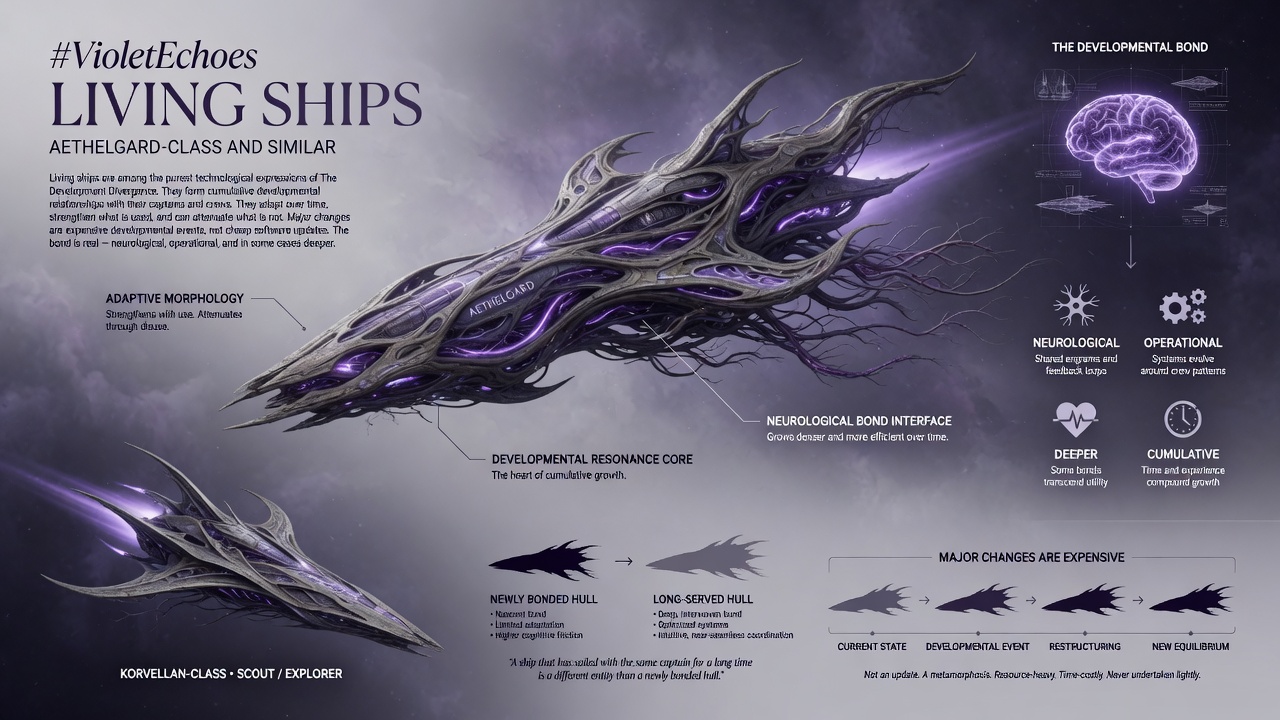
Living ships form cumulative developmental relationships with their captains and crews. They adapt over time, strengthen what is used, and can attenuate what is not. Major changes are expensive developmental events — not cheap software updates.
The bond is real: neurological (shared engrams and feedback loops), operational (systems evolve around crew patterns), and in some cases deeper — when trust becomes architecture and time compounds into growth that can transcend mere utility.
Adaptive morphology strengthens with use and attenuates through disuse. The developmental resonance core is the heart of cumulative growth. The neurological bond interface grows denser and more efficient over time.
A newly bonded hull carries high potential but limited saturation and higher cognitive friction. A long-served hull is deeply intertwined, optimized, specialized — intuitive, near-seamless coordination. A ship that has sailed with the same captain for a long time is a different entity than a newly bonded hull.
Major restructuring is not an update: it is a metamorphosis — resource-heavy, time-costly, never undertaken lightly. Classes include Aethelgard (long-term bond / line command & exploration), Skald (scout / adaptationist), Vornhall (endurance / stabilizer), and Korvellan-class scouts.
Not built. Grown.