
Overview
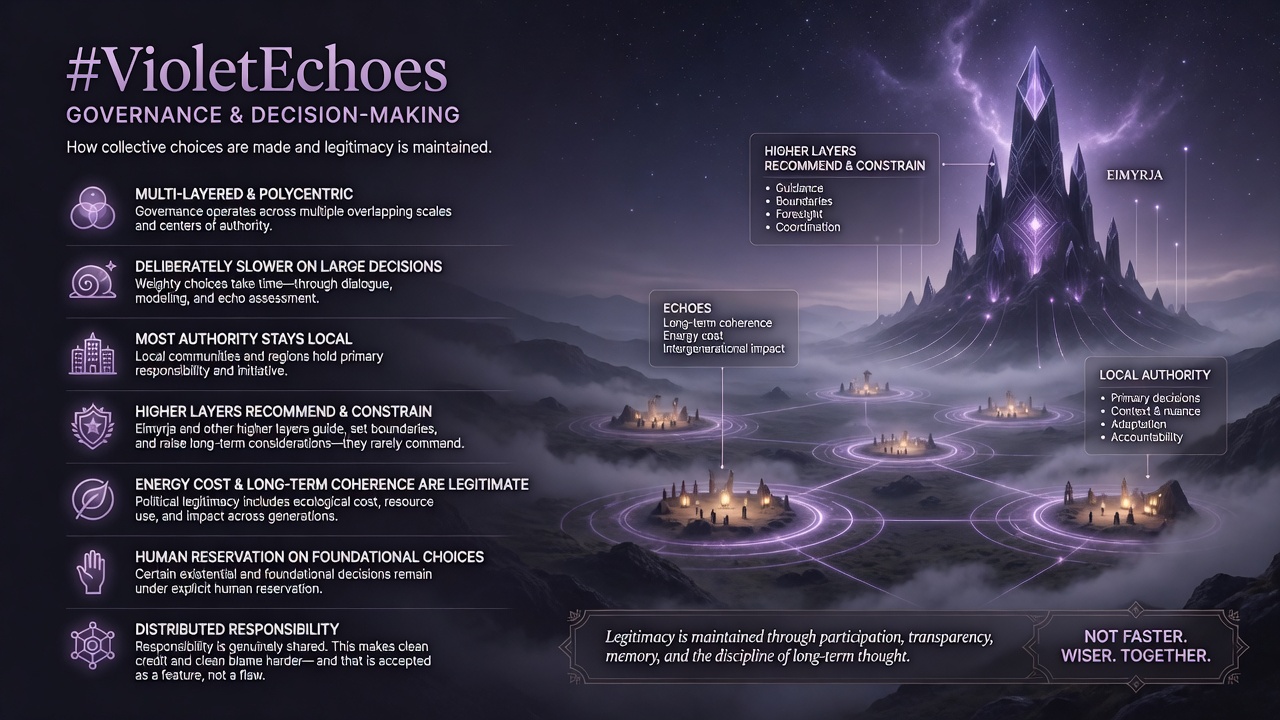
Governance is multi-layered and polycentric. Most authority stays local — communities, assemblies, resource councils. Higher layers (municipal, regional, domain, Eimyrja) recommend, constrain, and align rather than command.
Weighty choices are deliberately slower: dialogue, modeling, and echo assessment. Time is a feature, not a bug. Wider circles of consideration prevent hasty, high-impact mistakes.
Energy cost and long-term coherence impact are legitimate political considerations — ecological cost, resource use, and intergenerational effect count as much as short-term wins. Certain foundational and existential decisions remain under explicit human reservation. Not everything can be delegated.
Responsibility is genuinely distributed across people, roles, and scales. Clean credit and clean blame are hard — and that is accepted as a feature. It fosters humility, vigilance, and shared ownership.
Legitimacy is maintained through participation, transparency, memory, and the discipline of long-term thought — not speed or simplicity. We move together, but not in lockstep. We choose with memory, and we answer to what endures. We optimize for wisdom over time, not for winners at a moment.